


Every effective recycling program starts with the right ingredients. The Recycling Partnership’s Recipe for Recycling Behavior Change identifies four proven drivers: Access, Ease, Appeal, and Norm. Our behavior change strategies put those ingredients to work through practical, research-backed approaches to improving recycling participation and material recovery.
Container Designs to Physically Discourage Contamination
Install locking lids with a chute opening for recyclables on all recycling collection containers. A chute lid is a container lid with openings that allow only certain shapes or sizes of materials to enter (such as flattened cardboard or round cans and bottles) and keep out large items (such as bagged materials).
RESEARCH OUTCOMES
What’s Known & Why This Works
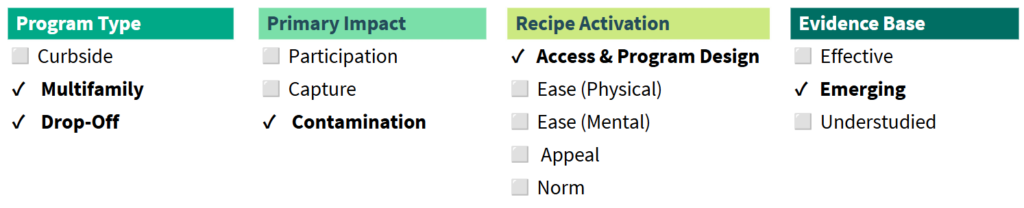
- Locking lids with a chute opening for recyclables have been part of successful contamination reduction initiatives in three communities – Peel, Ontario; City of SeaTac, Washington; and Denton, Texas.
- Two of the three studies included chute lids as part of a larger initiative; however, even when deployed alone, lids will likely reduce contamination.
- Additionally, lids are likely to have a more durable impact than educational strategies as the lids permanently make it more difficult to place large contaminants or bagged recyclables in the recycling container.
- This emerging strategy needs further study to confirm the effectiveness of strategy, the durability of impact, and the impact of chute lids on residents with disabilities.
Behavior Impact
- Up to 17% reduction in contamination levels
Estimated Cost Per Household (HH)
- Varies – highly dependent on size, type, and number of containers on-site.
IMPLEMENTATION GUIDANCE
Recommended Process
- Determine if the project will be limited to chute lids or combined with other strategies such as technical assistance or container labeling.
- Engage property managers early and include input from property managers in the process where appropriate.
- Leverage existing relationships that may already exist within a community or organization (housing authorities, apartment associations, condo associations.
- Communicate with property managers at the program roll out and on an ongoing basis.
- Conduct baseline measurement, implement the program, evaluate and adjust as needed.
Things to Consider
- Depending on contamination levels and budget, chute lids can be installed on routes with the highest levels of contamination or properties with the highest levels of contamination.
- There may be an unintended impact of chute lids on residents with disabilities, and this should be explored prior to roll out.
Measurement Recommendations
- Good: Visual observations of containers to assess contamination and fullness, documenting trends overtime.
- Better: Standardized pre-and-post inspections on fullness and contamination, supported by photos or app-based tools.
- Best: Pre- and post- waste audits to measure capture and contamination.