


Every effective recycling program starts with the right ingredients. The Recycling Partnership’s Recipe for Recycling Behavior Change identifies four proven drivers: Access, Ease, Appeal, and Norm. Our behavior change strategies put those ingredients to work through practical, research-backed approaches to improving recycling participation and material recovery.
FEET ON THE STREET (FOTS): CART TAGGING + MAILERS
Deploy cart tagging (four rounds) that provides immediate, specific feedback paired with a simple corrective instruction when contamination is observed. Second offenses trigger rejection of service (recycling not collected) until the contaminant is removed. Share a press release and provide basic instructions by direct mail before and during the program.
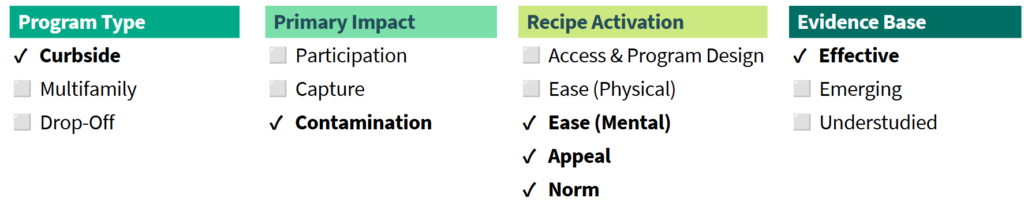
RESEARCH OUTCOMES
What’s Known & Why This Works
- FOTS targeted engagement has been shown to reduce contamination by 19-62% while maintaining or increasing average household recycling set-out.
- The impact lasts 10 months to three years, depending on follow-up education and outreach.
- Feedback, coupled with service rejection, turns recycling from an abstract expectation into a visible social interaction. Specific, actionable feedback, paired with clear next steps, increases correct behavior.
- Cost-efficiency and effectiveness are maximized in areas with higher contamination, where improvement potential is greatest, and in urban/suburban areas with universal recycling services.
Behavior Impact
- 19–62% contamination reduction
- Set-outs: maintained or increased
Estimated Cost Per Household (HH): $8-12/HH
IMPLEMENTATION GUIDANCE
Recommended Process
- Establish baseline data on contamination.
- Before inspections begin, share a press release and send an informational mailer to explain the initiative, build trust, and provide basic instructions.
- Inspect each cart four times over four consecutive collection cycles. Issue warnings first and then reject service for households where contaminants persist.
- Mid-program, send a mailer addressing the top contamination issue.
- Collect contamination data to compare with baseline levels.
Things to Consider
- Focus on a short list of priority contaminants (e.g., bagged recyclables, plastic film) to avoid message dilution.
- Use a dedicated crew and train inspectors to apply tags consistently.
- Use durable materials like waterproof tags and rubber bands to tie tags to cart handles.
- Pair Feet on the Street with ongoing outreach and continuous programming for lasting impact.
Measurement Recommendations
- Good: Simple counts of set-out rate (how often a cart is set out) and tagging occurrences by the tagging crew, combined with hauler tonnage data.
- Better: Add a mobile app to track tagging rates, contamination trends, set-out rates, participation rates (if a cart is set out at least once per 30 days), and container fullness rates.
- Best: Add pre- and post-contamination audits.
Variations
- Curbside
- See Strategy for “On-Truck Smart Cameras” and “Hybrid” approaches to curbside inspections and feedback.
- Less than four rounds of cart tagging: This may yield less dramatic results than the full four-round model. In limited studies, a two-round approach still demonstrates meaningful contamination reduction.
- Drop-Off
- Adapt with in-person staff to interview patrons and review materials brought for recycling. See Strategy for “Feet on the Site.”
ADDITIONAL RESOURCES
- Toolkit: Recycling Contamination Reduction Kit: 5 Steps to Replicate The Recycling Partnership’s Feet on the Street Cart-Tagging Campaign
- Case Study: Improving Quality in Orange County, FL