


Every effective recycling program starts with the right ingredients. The Recycling Partnership’s Recipe for Recycling Behavior Change identifies four proven drivers: Access, Ease, Appeal, and Norm. Our behavior change strategies put those ingredients to work through practical, research-backed approaches to improving recycling participation and material recovery.
Smart Camera Inspections + Feedback by Mail
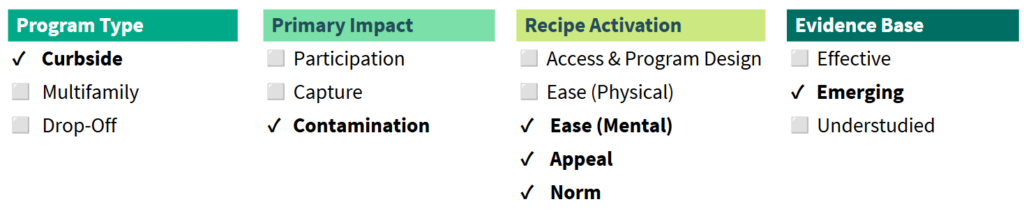
Collection trucks equipped with smart cameras identify contamination in recycling carts as materials are collected. When contaminants are found, households receive a postcard with images of their cart and the incorrect items clearly highlighted and labeled.
RESEARCH OUTCOMES
What’s Known & Why This Works
- Initial studies of this emerging strategy have reduced contamination by 23-41%. Duration of impact of this emerging strategy is not yet known.
- Feedback transforms recycling from an abstract expectation into a visible social interaction. Specific, actionable feedback increases correct behavior when paired with clear next steps.
- Cost-efficiency increases in multi-year implementations since the hardware installation is a fixed cost.
- The smart camera approach may be more suitable than cart tagging for urban/suburban areas with opt-in service models, and potentially for open-market and rural routes.
Behavior Impact
-
23-41% contamination reduction
Estimated Cost Per Household (HH)
- $5-10 per household – year 1
- $3 per household, year 2 and onwards
IMPLEMENTATION GUIDANCE
Recommended Process
- Establish baseline contamination occurrence data over at least four recycling collection cycles.
- Before inspections begin, send an informational mailer to explain the initiative, build trust, and provide basic instructions. A press release is also recommended.
- Send a feedback mailer with one occurrence of bagged material (bagged recycling or bagged waste) or when two or more other contaminants are identified. Recommended duration: minimum of four collection cycles.
- Collect post-data to compare with baseline levels.
Things to Consider
- Typical installation uses one camera facing towards the street (to measure set-out and verify address) and a second inside the hopper (to inspect tipped materials and take pictures).
- Hauler buy-in is critical to a successful project.
- If cameras are only on select trucks, for consistency, it is best to have the trucks stay on a consistent route throughout the entire project. This allows household level behaviors to be measured as reliably as possible before, during and after direct feedback through mailers.
- Responsible data management is essential to maintaining public trust and delivering high-quality recycling services. Where local government guidance is limited, ensure data is securely stored, appropriately used, carefully shared, and properly disposed of, with clear safeguards for partner and vendor compliance.
Measurement Recommendations
- Good: Contamination occurrences and collection tons (garbage and recycling).
- Best: Contamination occurrences, material audit, collection tons.